Why Scientists Need a Website
A scientist’s website is not a vanity project. It’s a *credibility engine* — a place where your work, links, and context live in one dependable, searchable home.
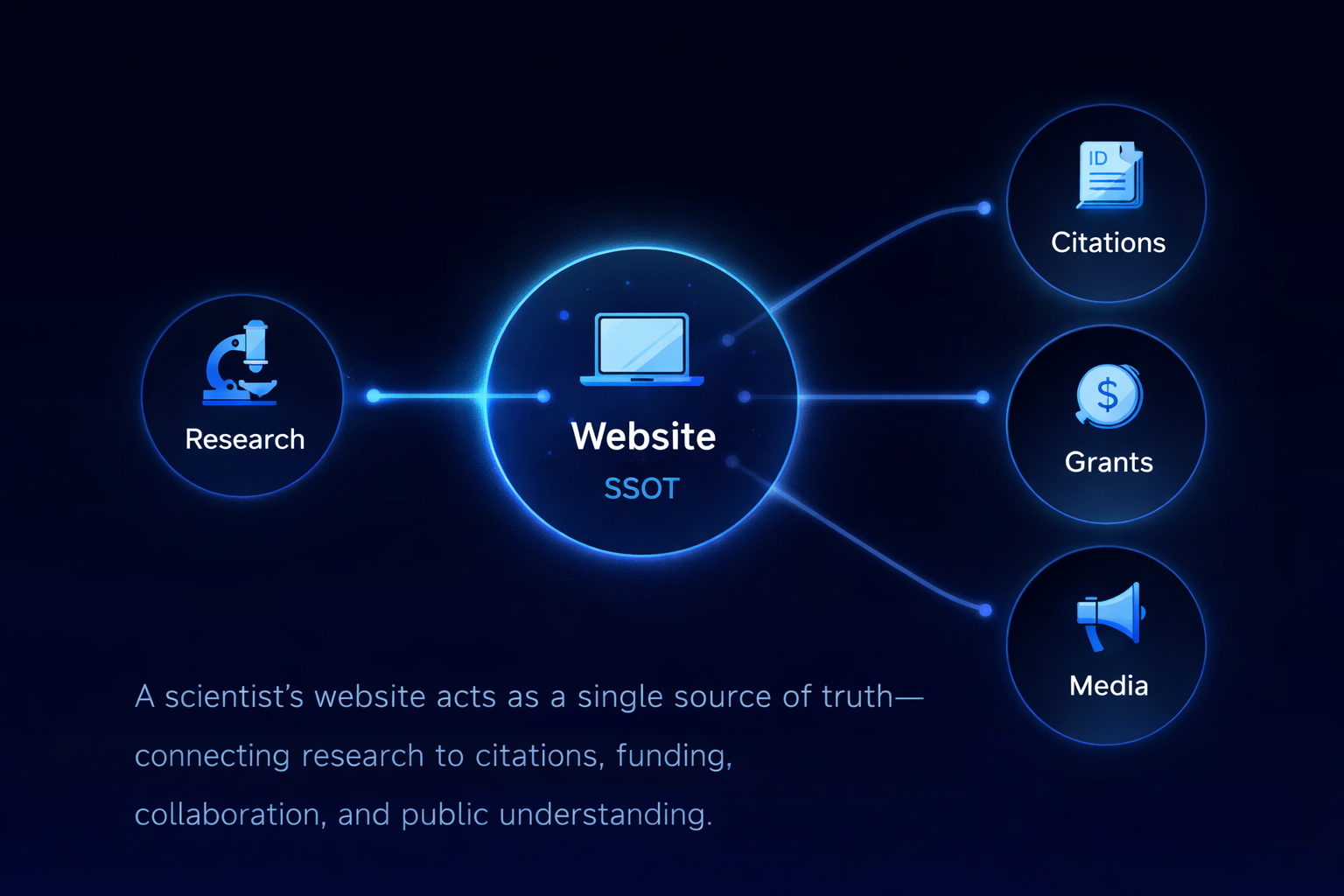
Most scientists already have an online presence — it’s just scattered. A Google Scholar profile here, a university page there, a conference bio somewhere else, plus a PDF CV in somebody’s inbox. That fragmentation costs you visibility and control.
Scientists, researchers and technical professionals face a unique problem: their work is complex, rigorous, and often misrepresented when reduced to PDFs, profiles, or third-party platforms.
Devenmark designs websites for scientists who want control over how their work is presented, clarity without oversimplification, and credibility that extends beyond institutional pages.
These are not “personal sites” in the marketing sense. They are structured, technical communication systems built to support research visibility, collaboration, funding conversations, and public engagement.
1 Discovery: make it easy to find you (and your work)
Search engines are how collaborators, journalists, students, and even hiring committees start. If the top results for your name are incomplete or messy, you’re silently losing opportunities. A well-structured website helps your work surface for the right keywords: methods, organisms, instruments, diseases, regions, or research themes.
- Publications that are readable and clickable (with DOIs).
- Projects explained in plain language (so non-specialists can follow).
- Keywords that match what people actually search.
2) Trust: credibility is a user experience problem
Scientists don’t love marketing. Fair. But trust still needs to be communicated. A clean website signals professionalism, care, and stability — especially when someone is deciding whether to cite you, invite you, fund you, or collaborate with you.
3) Grants & funding: show impact without writing a novel
Grant reviewers are busy humans. They often want to quickly confirm: “Is this person legit?” and “Does this group deliver outcomes?” A website can act as a living impact page — projects, outputs, collaborators, and results — organized so it’s obvious in under 30 seconds.
- Project pages with goals, methods, and outcomes
- Links to datasets, code, and supplementary materials
- Press, outreach, and public engagement
- Team members + roles (for labs and groups)
4) Your CV becomes interactive (and far less painful)
A PDF CV is fine… until it’s not. Your website can keep the CV *current* without you resending “latest_final_v7.pdf” to everyone forever. Add the PDF for formality, but also provide human-friendly pages for publications, talks, teaching, supervision, and service.
5) Recruitment: students and collaborators will judge your lab online
Students, postdocs, and collaborators don’t just look at your papers. They look for signals: Are you active? Is the lab welcoming? What problems do you work on? What tools do you use? A lab site can communicate culture, expectations, and opportunities — without a thousand emails.
6) Outreach: make your science legible to the world
If you care about public impact, your website is your most flexible outreach tool. You can publish readable summaries, media resources, FAQs, and “here’s what we actually found” explainers that journalists can link to (correctly).
What a great scientist website includes
You don’t need a giant site. You need a useful one. Here’s a proven structure that stays low-maintenance:
- Home: a clear one-paragraph description of your research + key links
- Publications: titles, short summaries, DOI links, and filters by topic/year
- Projects: current work + outcomes + collaborators
- Talks & teaching: slides, recordings, course pages
- About: affiliations, awards, service, and a downloadable CV
- Contact: simple, spam-resistant, and clear
Common worries (and the boring truth)
“I don’t have time to maintain it.”
That’s why we build scientist sites to be “update-light.” Your publication list can be updated by adding a DOI. The layout stays stable. The site stays fast.
“My university already has a page.”
University pages are useful, but you don’t control them — and they’re rarely optimized for discovery or clarity. Your personal site links to the university page, not the other way around.
“Isn’t this self-promotion?”
It’s documentation. In science, clarity and reproducibility are virtues. A website is simply the most readable format for your work and context.
How Devenmark builds websites for scientists
Our approach is simple: credible design + technical performance + research-friendly structure. We build sites that load fast, read well, and make your work easy to cite. That usually includes:
- Publication-ready layouts with DOI/ORCID linking
- Clean information architecture (people find things fast)
- SEO that respects scientific intent (not clickbait)
- Accessibility and global credibility polish
- Optional: forms and lead routing for labs/centres
Send us your name + field + links (Scholar/ORCID), and we’ll suggest a structure and a clean home page narrative that fits your research.